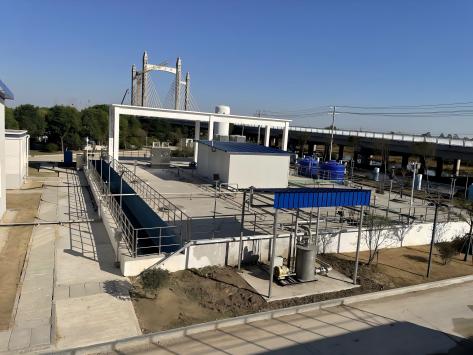
1. Heterogeneous advanced oxidation
Ozone heterogeneous advanced oxidation is the introduction of solid catalysts on the basis of ozone contact oxidation, and the synergy between the active metal oxides and ozone of the solid catalysts is used to produce more strong oxidizing active species (such as OH, O₂⁻, etc.), which significantly improves the degradation efficiency and mineralization rate of pollutants and improves the ozone utilization rate.
The specific processes of the synergistic effect of ozone and heterogeneous catalysts mainly include:
1) Adsorption of ozone on the surface of the catalyst
The presence of metal active sites (e.g., Fe³⁺, Co²⁺, Mn⁴⁺) on the surface of heterogeneous catalysts can adsorb ozone molecules in water to the surface through electrostatic gravity, coordination, or van der Waals force, forming "ozone-catalyst" adsorption complexes (e.g., Meⁿ⁺-O₃⁻), which provide the basis for subsequent activation.
2) Activation of ozone and generation of active species
The ozone adsorbed on the surface of the catalyst is activated by the active site, undergoing cleavage or electron transfer, and generating a variety of active species, the core reaction pathways include:
Hydroxyl radicals (・OH): Metal ions (such as Co²⁺) or hydroxyl groups on the surface of the catalyst can react with ozone, triggering ozone decomposition to form ・OH (redox potential of about 2.8 V, one of the most oxidizing species in water), reaction example: Co²⁺ + O₃ + H₂O → Co³⁺ + · OH + OH⁻ + O₂
Superoxide radicals (O₂⁻・): Some catalysts (such as carbon-based materials) can reduce ozone to O₂⁻・ through electron transfer, and O₂⁻・ is further combined with H⁺ to form ・OH or participate in the oxidation of pollutants;
Surface adsorbed reactive oxygen species (ROS): After the activation of ozone on the surface of the catalyst, ozone may form adsorbed reactive oxygen species such as O₂²⁻ and O⁻, which directly oxidize with the pollutants adsorbed on the surface.
3) Oxidative degradation of pollutants
The generated ・OH can inadvertently attack unsaturated bonds or easily oxidizing groups such as double bonds, benzene rings, and ether bonds in pollutant molecules, gradually decompose macromolecular refractory pollutants (such as pesticides, antibiotics, dyes, endocrine disruptors) into small molecule organic matter, and finally mineralize into CO₂, H₂O and inorganic ions (such as Cl⁻, NO₃⁻, SO₄²⁻) to achieve complete removal of pollutants.
The heterogeneous catalysts produced by Longjing Xinlu have high compressive and wear-resistant structure, moderate porosity and specific surface. It has a self-developed formula for highly active rare elements, using a special mixing method to fully and evenly mix with the substrate, combined with precise temperature-controlled sintering, to form a superior microscopic crystalline structure, the catalytic surface is easy to form active coordination points and holes, more effectively generate catalytic free radicals, and has the advantages of no loss and no loss.
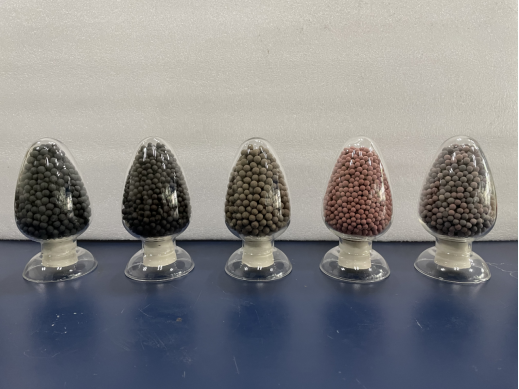
Advantages and characteristics of heterogeneous catalysts:
The mixing process combined with precise temperature control sintering has high ozone utilization.
High active components, low resistance, and low loss rate;
The dosage is small, the flow rate of the empty bed is high, which effectively shortens the residence time;
High compressive strength and good wear resistance, not suitable for loss and breakage, long service life;
2. Homogeneous advanced oxidation
Ozone homogeneous advanced oxidation technology refers to the addition of transition metal ions or hydrogen peroxide to water, the transition metals mainly include Fe²⁺, Mn²⁺, Ni²⁺, Co²⁺, Cd²⁺, Cu²⁺, Ag⁺, Cr3⁺, Zn²⁺, etc., which triggers ozone decomposition to produce superoxide radicals O²- ·, then electron transfer occurs to form O²- ·, and finally strongly oxidizing · OH, these free radicals are more likely to oxidize and degrade organic matter into low-toxicity or non-toxic small molecule organic matter.
1) Ozone + hydrogen peroxide homogeneous advanced oxidation technology
Ozone + hydrogen peroxide homogeneous advanced oxidation technology does not use ozone to react directly with organic matter, but uses hydrogen peroxide to add ozone to aqueous solution to accelerate the decomposition to produce OH, and the reaction equation is as follows:
O₃ + H₂O₂ → 2· OH +3O₂
2) Advanced oxidation technology of ozone + homogeneous phase reactor
The advanced oxidation technology of ozone homogeneous reactor is to accurately add trace amounts of transition metal ions to the sewage through the homogeneous reactor to form an unstable complex with ozone, promote the decomposition of ozone and generate hydroxyl radicals.
Advantages and characteristics of advanced oxidation of ozone homogeneous:
The combination is flexible and the reaction rate is high, which can efficiently promote the efficient production of hydroxyl radicals.
The reactor has a simple structure and a small footprint;
It is suitable for sewage treatment with high chlorine and high salt.
3. Advanced oxidation coupling process
The ozone advanced oxidation coupling process is based on ozone, combined with a variety of ozone advanced oxidation processes (combining light, electricity, sound, magnetism and catalysts, etc.), which can efficiently promote the production of hydroxyl radicals, improve ozone utilization, and ensure the standard discharge of sewage treatment.
Common ozone advanced oxidation coupling processes include: ozone photocatalytic coupling process (O₃/H₂O₂/UV). The two synergistic mechanisms are as follows:
1) Ozone is first decomposed into oxygen atoms under the action of ultraviolet light, and the oxygen atoms react with water to form hydroxyl radicals:
O3 + hv → O· + O2
O· + H2O → 2· OH
2) Ozone reacts with water to form hydrogen peroxide under ultraviolet irradiation, and hydrogen peroxide further decomposes to form hydroxyl radicals:
O3 + hv + H2O → H2O2 + O2
H2O2 + hv → 2· OH
Advantages and characteristics of Longjing Xinlu advanced oxidation coupling process:
The only leading enterprise in China with both ozone generator and ultraviolet equipment production;
Wide adaptability, can be applied to all kinds of refractory pollutants;
avoid by-products;
There are many cases of advanced oxidation operation, and professional engineering experience is rich.